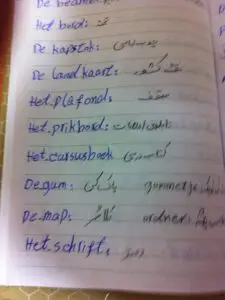


Dutch B1- The Main Points
Language level B1 is mandatory for those who are required to integrate. Read here the main points of Dutch at language level B1. The B1 exam requires 4400 words and the building of long sentences with the correct word order. Continue reading for more information.
However, expats who want to apply for naturalization are a special group with different rules. Please check in Integration Exam requirements for expats
Author: Margreet Kwakernaak, director of Suitcase talen, and author of Dutch for Dummies
Dutch at language level B1 – 4400 words
Level A2 is not enough for work or social life in the Netherlands. Though living in English may be an option in towns with 200,000+ inhabitants, life outside Amsterdam, Utrecht, The Hague, Rotterdam and Eindhoven is better when you speak Dutch at level B1.
First of all, for level B1 you must know 4400 words, the double of 2200 required for level A2. Consequently, reaching level B1 takes twice as much time as level A2. Fortunately, you are not expected to know 4400 words actively. You should understand those 4400 when you read or hear them. Luckily, the other words in the text will help you to understand. Moreover, the more languages you know already, the easier you will guess the meaning of words. Read more about word acquisition in Word learning: make it part of your daily life
The e-learning of the Delft method offers you those 4400 words. However, doing the e-learning by yourself is tough – what you learn with it is meant to be practiced in a group! In Delft method conversation classes only Dutch is spoken. You will answer the questions of the teacher and you will speak Dutch with the other students. As the e-learning of the Delft method is based on texts, your reading skills improve as fast as your speaking and listening skills.
What comes first: reading. Dutch B1 – The Main Points
To master a level means that you have all four skills: reading, listening, speaking, and writing. Consequently, to pass the Civic Integration Exam B1 means that every skill has to be at that level B1.
Provided that you grab every opportunity to understand parts of texts that pass your eyes in your Dutch life, you’ll master the reading skill first. Guess first, and only then check your phone for the meaning of the new words!
When your child is at a Dutch school, at level A2 you understand most notifications of that school. However, level B1 is needed in case there are complications around your child or in your own life. You understand written texts at an intermediate level. Unfortunately, Dutch at level B1 is not sufficient to understand texts aimed at highly educated people. For that, you need level Dutch at level B2.
Dutch B1 – The Main Points. Listening skills or ‘luistervaardigheid’
Regarding listening at level B1- you will only reach that level if you expose yourself to it dayly. Listening comprehension is such a complicated skill, that class only is not enough. You must exercise much more! Factors like speaking speed, regional accents, bad articulation, ambient noise and not knowing the subject the person is speaking about, play a big role. Start with watching Dutch TV for 15 minutes daily: all the above factors are in it.
But, how to remember the new words? Read How to remember words, the seven steps
Hearing Dutch should become normal first, and as your vocabulary grows, you’ll understand more. When you finally dare to talk with a Dutch person and that person is speaking fast, ask: ‘Kunt u wat langzamer spreken alstublieft? – Can you speak a bit slower, please? At level B1, a speaker should take you into account.
Speaking at B1 is using sentences connected by ‘dat’, ‘omdat’, or ‘als’.
In the act of speaking, all your skills come together. Do the words you need come up in time, do you understand the person who talks to you, and does the other person understand you? If not, you are probably at level A2 or lower.
Moreover, for level B1 more is needed: you should speak in compound sentences, using the correct Dutch word order after words like ‘dat’, ‘omdat’, or ‘als’.
Either way, speaking in a new language takes courage. Courage helps you to overcome your shame. For sure, you are not the only language learner who is fighting shame and fear! However, once you accept that making mistakes is a normal part of any learning process, you’ll start to speak. By trial and error, you’ll find your way. It is easier to remember words that someone said to you than from books.
Finally, B1 will put an end to the frustration that all A2- speakers feel. At level A2 you can never tell what you mean. On the other hand, at level B1 you’re almost there – very complex situations excepted.
Writing Dutch at level B1: the last hurdle
If you want to pass the Dutch integration exam B1, you must pass the last hurdle: writing at level B1. What are the requirements? They are the same as for speaking at B1. Most importantly: at level A2 short sentences will do.
For example, when telling about yourself:’ Ik woon in Almere. Wonen in Amsterdam is erg duur. Ik rijd nu elke dag naar Amsterdam. Ik werk in Amsterdam’.
However, level B1 requires more complex sentences: ‘Ik woon in Almere, omdat wonen in Amsterdam erg duur is. Maar, omdat mijn werk in Amsterdam is, rijd ik elke dag naar Amsterdam’.
Though you may not write a lot in your Dutch life, once you can make sentences when speaking, writing will follow. Moreover, when writing you have more time to think. As a consequence, some students prefer writing to speaking!
Passing the Dutch integration exam B1. Do language programs help?
We cannot finish our Dutch B1 – The Main Points without mentioning the help of language tools and apps. We all use them, professionals as well.
I mention three language programs that help thousands of students to learn Dutch.
The most famous translation program is Google translate
This program continues expanding its knowledge: it learnes from the words students search for.
Almost as renown is duolingo. It’s fine for beginners who don’t want to spend money on language learning, but do have time to to spend on quietly and systematically learn a language. The program is playful and challenges you to continue learning. That helps, but also may distract you from your target : some users are more concerned about their points in the program than using the language in real life. You cannot have a live conversation with Duolingo!
The third useful group of programs that can help you, are AI programs. You can ask them to translate your language into Dutch, they can correct your Dutch sentences and they explain well, when you ask them questions concerning Dutch grammar. And, you might find more questions to be answered by AI programs!
A good teacher and the Delft method lead you to B1
However, up to now, no program replaces a good teacher who leads you up to level B1 on a personal base.
Experienced teachers, like doctors, are good observers. They quickly recognize which type of learner you are, and their tips and help are specifcfically aimed at you in one-to-one classes, and general in group classes.
Conclusion of Dutch B1 – The Main Points
- For Dutch B1 you need to know 4400 words
- You learn to read at level B1 by looking up new words every day
- 15 minutes of news every day, helps to achieve B1 listening skills
- Speaking at B1 means you can make sentences connected by ‘that’, ‘because’, and ‘if’
- Once you can speak at level B1, you can also write at level B1
- Tools like Google Translate and AI Programs help to reach B1
- A good teacher will lead you to Dutch B1 by the shortest possible route
Studying with Suitcase talen and the Delft method
The author of this blog is an experienced teacher. After preparing your class with e-learning, you meet Margreet Kwakernaak online, in a small group.
You have two 40 minutes evening classes per week. To offer maximum flexibility, modules are for 5 weeks only.
Are you highly educated and willing to invest 4-6 hours per week?
Read more in Courses
Don’t you know with which module to start? Use the Contact form mentioning
- How did you learn your actual Dutch and how long it did take
- What is your actual situation
- What is your target